¶ RDA 4.3 : 260 field (Imprints)
¶ Bracketed imprint information
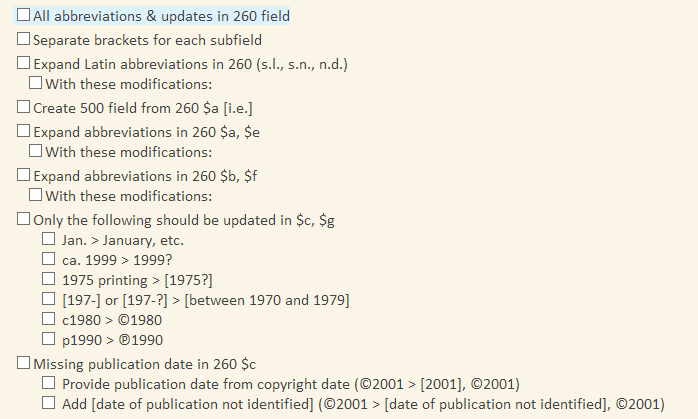
In AACR2, all information taken from outside the resource was put under the same set of brackets. Due to a change in ISBD, each element taken from outside the resource should be in its own set of brackets. MARS 2.0 will separate subfields contained in a single set of brackets into separate brackets around each subfield. RDA D.1.2.1 (html)
Original: 260 $a [New York :$b Macmillan, $c 1973]
 Updated: 260 $a [New York] :$b [Macmillan], $c [1973]
¶ Default
Expand all abbreviations & make all updates in 260 field.
¶ Latin abbreviations
AACR2 used the Latin abbreviations S.l., s.n., n.d. in the 260 $a, $b, $c, $e, $f, $g when the place of publication, publisher name, or dates were not available. With RDA, new phrases have replaced these Latin abbreviations.
- [S.l.] in $a is replaced with [Place of publication not identified] RDA 2.8.2.6 (html)
- S.l. in $e is replaced with [Place of manufacture not identified] RDA 2.10.2.6 (html)
- s.n. in $b is replaced with [publisher not identified] RDA 2.8.4.7 (html)
- s.n. in $f is replaced with [manufacturer not identified] RDA 2.10.4.7 (html)
- n.d. (rarely used) in $c is replaced with [date of publication not identified] RDA 2.8.6.6 (html)
- n.d. (rarely used) in $g is replaced with [date of manufacture not identified] RDA 2.10.6.6 (html)
Original: 260 $a [S.l. : $b s.n.], $c 1963.
 Updated: 260 $a [Place of publication not identified] : $b [publisher not identified], $c 1963.
¶ Create 500 from 260 i.e.
Sometimes an i.e. note is included in 260 $a. MARS 2.0 can move this information to a separate 500 field, if desired:
Original:
260 $a Garden City, N. York [i.e. New York] :$b Doubleday, $c 1979.

Updated:
260 $a Garden City, New York :$b Doubleday, $c 1979.
500 $a Published in New York.
Please note that New York in 260 $a is spelled out also as part of Step 4.3, but the i.e. part is what ends up in the 500 field as a Published in note.
¶ Abbreviations expanded
RDA uses standard abbreviations for most places such as states, countries, etc. Place names that don't have a standard RDA abbreviation will be spelled out in the 260 $a and $e. Also abbreviations such as Dept. and Co. that may be found in the 260 $b and $f can be spelled out. If you choose to have these changes made, be aware that it is 'all or nothing'. The system cannot determine if the abbreviation was that way on the resource. RDA 2.8.1.4 (html)
Original:
260 $a Am. Samoa : $b Dept. of Safety, $c 1987.

Updated:
260 $a American Samoa : $b Department of Safety, $c 1987.
¶ Dates
There are many changes in the way dates are recorded from AACR2 to RDA. The following are changes that can be applied by machine to the 260 $c. These changes are explained below.
With RDA, names of months of the year are not to be abbreviated in the 260. RDA B.5.11 (html) This change uses the same month abbreviation table as is used for changing access fields (see Step 5.2)
Original: 260 $a Paris : $b Le Robert, $c Jan. 2010.
 Updated: 260 $a Paris : $b Le Robert, $c January 2010.
In the 260 $c and $g, ca. is no longer used to represent circa or approximately. Instead, a question mark ? should be added after the date: RDA 1.9.2.3 (html)
Original: 260 $a London : $b O.Hodgson, $c [ca. 1830]
 Updated: 260 $a London : $b O.Hodgson, $c [1830?]
Printing or pressing dates can be used to supply a publishing date and enclosed within square brackets. LC-PCC PS for 2.10.6 (html)
Original: 260 __ $a New York : $b Knopf, $c 2010 printing.
 Updated: 264 _3 $a New York : $b Knopf, $c [2010]
Note that printing can also be useful if converting the 260 to 264 field(s).
With AACR2, a dash could be used to represent an unknown number within a date. In using RDA, the dash is no longer used. A range of dates encompassing the unknown number should now be used. If there is a question mark included in the date, the question mark should remain at the end of the date range. RDA 1.9.2.4 (html) The following types would be changed in 260 $c:
- Decade is certain: [197-] becomes [between 1970 and 1979]
- Probable decade: [197-?] becomes [between 1970 and 1979?]
- Century certain: [18--] becomes [between 1800 and 1899]
- Probable century: [18--?] becomes [between 1800 and 1899?]
When either a c or p is the character right before a date, they should be changed for either the copyright symbol © or phonogram symbol ℗. The words 'copyright' and 'phonogram' should also be changed to the appropriate symbol. RDA 2.11.1.3 (html)
Original: 260 $a Berlin : $b Gerschel, $c c1964.
 Updated: 260 $a Berlin : $b Gerschel, $c ©1964.

Original: 260 $a New York : $b Anchor Books, $c p2001.
 Updated: 260 $a New York : $b Anchor Books, $c Ⓟ2001.
As explained above, the copyright or phonogram date can be used to supply a publishing date when missing. LC PCC PS for 2.8.6.6 (html)
¶ Missing publication date
PCC/LC policy is to try to supply a date of publication if at all possible rather than use the phrase 'date of publication not identified' LC PCC PS for 2.8.6.6 (html). If the publication date is not available and a copyright date, or phonogram date is available, we can use these dates to supply a probable publication date. Or if preferred, we can include the phrase [date of publication not identified]
Original: 260 $a London : $b Collins, $c c1965.
 Updated: 260 $a London : $b Collins, $c [1965], c1965.
¶ Links
4.1 - 4.2 - 4.3 - 4.4 - 4.5 - 4.6 - 4.7 - 4.8